


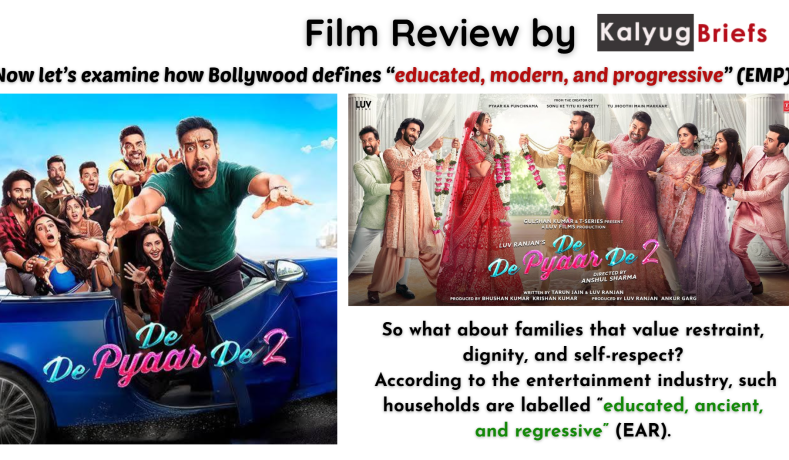
Film Review: De De Pyaar De 2 — When “Progressive” Means Losing the Plot
Imagine this timeline.
A 24-year-old man spends his youth chasing women his own age—dating casually, using the “have fun now, settle later” philosophy. Somewhere else, a baby girl is born. Fast forward 27 years: she’s now a young woman, and he’s 51. Bollywood waves a magic wand, background music swells—and voilà! We’re expected to applaud this as a grand love story.
In any ordinary middle-class household, such a man would be called deeply problematic, opportunistic, and emotionally stunted. But De De Pyaar De 2 rebrands him as a “romantic hero,” generously rewarding ageing lust with a fresh coat of charm. The film doesn’t just normalise the fantasy—it celebrates it, almost as if giving moral validation to every self-proclaimed tharki uncle who refuses to age with dignity.
Now let’s examine how Bollywood defines “educated, modern, and progressive” (EMP).
The daughter of an EMP family gets drunk in a nightclub, passes out due to excessive alcohol, and is taken home by the much older man. He dumps her—unconscious—into a bathtub. She wakes up confused the next morning, in his house. Instead of questioning boundaries, safety, or basic common sense, she is impressed. Why? Because he didn’t take advantage of her.
Apparently, the bare minimum of human decency is now enough to trigger romance—especially when compared to the behaviour of men her own age, who the film subtly implies are far worse. This becomes the turning point: she rebels against her family, fights them publicly, abuses her father on the street, flashes the middle finger, drops the “F-word”—and forces acceptance of the relationship.
Cue applause. This, ladies and gentlemen, is cinematic “progress.”
One scene briefly tells the truth: the father bluntly calls the situation what it is. But the film swiftly frames him as regressive, judgmental, and out of touch—because in Bollywood logic, parents who question exploitative dynamics are villains, and daughters with zero boundaries are icons of empowerment.
Frequently Unasked Questions (But Answered Anyway)
Qs. Why does Bollywood keep encouraging young women to expose their bodies and treat casual sex as empowerment?
Because it sells. Item numbers, semi-nude performances, and sexualised imagery are the real box-office magnets. What earlier required secrecy—voyeurism, indulgence, objectification—is now packaged as entertainment and streamed straight into living rooms. Demand creates supply, and the industry happily feeds it.
Qs. So what about families that value restraint, dignity, and self-respect?
According to the entertainment industry, such households are labelled “educated, ancient, and regressive” (EAR).
In reality, these are families that raise strong individuals—people who understand boundaries, self-worth, and emotional responsibility. They don’t confuse rebellion with empowerment, nor impulse with freedom.
Final Verdict
De De Pyaar De 2 isn’t just tone-deaf—it’s ideologically lazy. It dresses imbalance as romance, indulgence as liberation, and moral confusion as modernity. Beneath the humour and gloss lies a troubling message: ageing men deserve validation, young women should adjust, and questioning this equation makes you backward.
Progress deserves better storytelling. This film doesn’t deliver it.
Leave a comment